Bromley Development Finance 2026: Town-Centre Regeneration, Capital Stack & Sold Prices
While Greater London’s headline house-price index fell 3.3% year on year in February 2026 to a regional median of around £542,000, Bromley is up 3.0% over the same window. That is a relative outperformance of 6.3 percentage points against the regional benchmark. It is not the loudest number in the borough table — Walthamstow at +5.9% and Redbridge at +5.3% sit higher — but Bromley is the cleanest of the three. No Elizabeth Line spillover. No headline regen consent. Just a town-centre regeneration playbook that has been delivering quietly for four years.
This piece is the operator-level read on why Bromley is the quietest outperformer in the outer south, what the £650 per square foot viability line means for Bromley GDV, what lenders are actually pricing on Bromley schemes in 2026, and how the capital stack works on a typical mid-cap scheme in the borough today.
Why Bromley is the quietest outperformer — the town-centre regen thesis
Bromley is the largest London borough by geography and one of the most underwritten by national capital. Most of the borough is suburban, low-density and outside the £650 per square foot threshold. But the town centre is not. The Glades retail anchor, the Pavilion leisure block, the Bromley South interchange, and the run of consented and built mid-rise resi schemes north of Westmoreland Road have been quietly densifying for four years.
The town-centre regeneration playbook here is not headline-driven. There is no single signature project the way Earls Court or Royal Docks anchors a borough. Instead, there is a steady release of 80 to 250 home town-centre schemes — typically 6 to 12 storeys, brownfield, resi-led with active ground-floor retail — clearing values in the £700 to £750 per square foot range. That is comfortably above the £650 viability threshold without requiring a transport miracle and without the planning friction prime central is currently experiencing.
The Tramlink spillover from Croydon’s network and the Bromley South interchange position into Victoria and Blackfriars give the borough a credible connectivity story for buyers who would historically have bought in Beckenham, Bickley or southern Lewisham. That migration is sticky — it is being driven by relative pricing and family-housing depth, not by a single new line.
Reading the +3.0% in context
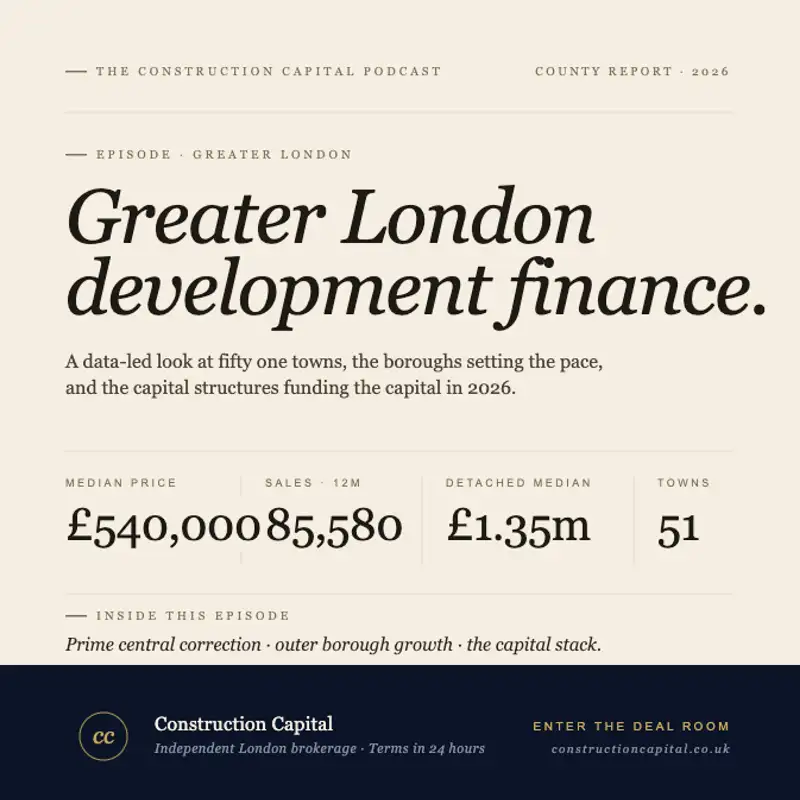
The London median across 51 principal towns sat at £540,000 over 85,580 transactions in the rolling twelve months to February 2026. New-build completions ran at just 1.9% of total activity. Against that backdrop, Bromley’s +3.0% reflects three things at once.
First, demand depth. Bromley’s price growth is being supported by buyers exiting Lewisham, Greenwich and parts of Bromley’s own commuter villages who want larger family stock at prices that no longer pencil in inner south. The same migration is showing up further east in Bexley and to the west in Sutton, but Bromley town centre is the focal point because the new-build supply is concentrated there.
Second, supply discipline. Bromley’s town-centre AAP and the consented pipeline behind it have been releasing in measured tranches rather than landing in single large drops. That has kept absorption strong without saturating any one phase. Against London’s collapsed BTR completion run rate — London BTR starts fell 93% between 2022 and 2025 — Bromley’s mid-cap resi pipeline has been one of the few outer south locations where institutional take-out conversations are credible.
Third, viable land basis. Recent off-market trades in the town centre indicate residual values that work above £650 per square foot, the threshold Molior’s analysis identifies as the binary line between viable and undeliverable for most of the capital. Of the 281,000 unbuilt consented homes across Greater London, only 119,200 sit above that threshold. Bromley town-centre consents represent a meaningful and disproportionate share of the south-London side of that 119,200. The contrast with prime central could not be sharper — Kensington and Chelsea is down 11.2% and Westminster 10.8% over the same window, and even at twelve hundred pounds per square foot those falls are eating margin headroom rather than triggering re-pricing.
For context, Croydon is on a similar trajectory at +2.5% but has a less linear story — its growth is concentrated in the East Croydon transport hub and the Whitgift redevelopment area, with outer Croydon postcodes sitting closer to the viability line. Bromley’s number is more uniformly underwritten by the town-centre regen.
What lenders are pricing on Bromley schemes in 2026
Following the Bank of England’s December 2025 cut to 3.75%, the all-in capital stack on a typical Bromley town-centre scheme is clearing in the tightest band since 2022.
Senior development finance is available from 6.5% per annum at 65 to 70% LTGDV for an experienced developer with strong cost certainty on a town-centre resi-led scheme in the 80 to 250 home range. Stretched senior products start around 7.5% and reach 75% LTGDV where the cost plan and contractor are bankable. Mezzanine finance pricing starts at 12% per annum and stretches gearing to 85 to 90% of cost. Bridging on auction acquisitions and pre-planning land assembly starts from 0.55% per month at up to 75% LTV.
Bromley sees less BTR forward funding than Croydon — institutional BTR has been more cautious about Bromley’s slightly thinner rental comparables — but PBSA appetite is real, given the borough’s commuter-belt education catchment and the proximity to multiple south-London university campuses. Forward-funded PBSA take-outs on the right scheme are clearing 5.50% net yields, which compresses senior pricing on the construction layer because take-out risk is removed.
For the right Bromley town-centre scheme, blended all-in pricing is now landing in the 6.5% to 9.0% range. That is the operative number when running a Bromley viability appraisal in this rate environment.
What is actually transacting in Bromley
Three categories of scheme are running across Bromley in 2026.
Town-centre intensification on resi-led brownfield. Typically 6 to 12 storeys with active ground-floor retail, between 80 and 250 homes. These are the schemes clearing fastest under the Time-Limited Planning Route at 20% affordable housing by habitable room. Absorption in the town centre is supporting GDV rather than discounting it.
Mid-cap PBSA on town-centre and college-adjacent sites. The borough’s education catchment supports an institutional take-out at 5.50% net yields. This is one of the few outer-south asset classes where the capital stack is competitive with anywhere in connected outer London.
Suburban density-uplift schemes. Typically 6 to 30 home town-house and apartment schemes in the strongest Bromley village catchments — Beckenham, Bickley, Chislehurst. These are senior-debt-financeable for established developers without needing mezzanine in most cases, but the £650 viability test is binary and many sub-village postcodes do not clear it.
How the capital stack works on a £15m GDV Bromley scheme
A typical Bromley town-centre scheme at this scale, with strong PTAL within a 10-minute walk of Bromley South or Bromley North, and a clean planning consent under the new NPPF regime, can be financed with senior development finance at 65% LTGDV (around 6.5% to 7%), mezzanine layered to 90% of cost (12% plus), and a modest equity or JV equity component to close the gap. Total senior plus mezz cost-of-funds blends in the high sevens.
On a slightly larger scheme (£25m to £60m GDV), the institutional senior pool re-engages, multiple mezzanine providers compete for allocation, and forward-funding conversations with PBSA operators come into view. That is the structural window the next twelve to eighteen months represent for Bromley town-centre development capital specifically. Compare to a sub-village Bromley site sitting on a £600 per square foot residual — the senior layer prices 50 to 100 basis points higher and the mezzanine appetite thins materially. That spread is now the operative input to every Bromley site appraisal.
What this means for Bromley site acquisition
If you are pricing land in Bromley in 2026, three things matter more than they have in any recent cycle.
One, the town-centre versus sub-village distinction is binary, not a sliding scale. A site within a 10-minute walk of Bromley South or Bromley North with a credible 6 to 12 storey resi-led play will clear viability and attract competitive senior debt. A site one mile out with the same residual price per square foot will not.
Two, the £650 per square foot test is being applied at term-sheet stage on the GDV input row of every appraisal. Lenders are not negotiating it. A Bromley scheme that does not clear it on credible market comparables is being declined before structuring.
Three, the post-NPPF planning regime, the Mayor’s emergency package and the Time-Limited Planning Route together favour schemes that move quickly. Capital is available for Bromley town-centre schemes ready to start, whether that is conventional development finance, bridging for a tight acquisition window, or a development exit refinance for a project completing in late 2026.
For full borough-by-borough sold price data, the Bromley town-centre regen pipeline references, viability modelling and the underlying capital stack benchmarks behind this analysis, see the Greater London Property Market Report 2026. Borough-specific intelligence sits on the Bromley location page.
See also: Walthamstow +5.9% on YouTube and The £650/sq ft Cliff on YouTube.
Listen to the full episode
For the dedicated deep dive on this borough, we have published a stand-alone Bromley episode of the Construction Capital podcast: Bromley +3.0%: The Quietest Outperformer in Outer London. Around ten minutes covering the town-centre regen thesis, the £650 per square foot viability test as it falls in Bromley, the full April 2026 capital stack, and what is actually transacting in 2026.
This article also draws on Episode 2 of the Construction Capital podcast: Greater London Property Development Finance 2026: Market Analysis, House Prices and Lending Outlook. The full borough-level data, policy detail and capital stack discussion runs 15:30, with chapters covering Bromley, Walthamstow and Redbridge within the wider Greater London outlook.
Listen anywhere
Listen on Apple Podcasts, Spotify, Overcast, Pocket Casts, or Amazon Music.
For indicative terms on a Bromley scheme within 24 hours, submit through the Construction Capital deal room.
Published by Construction Capital, an independent capital advisory brokerage sourcing terms from over 100 lenders across development finance, bridging, mezzanine, and equity. This article is part of a 20-piece Greater London 2026 series accompanying the Construction Capital podcast.